LIMONIUM SINUATUM
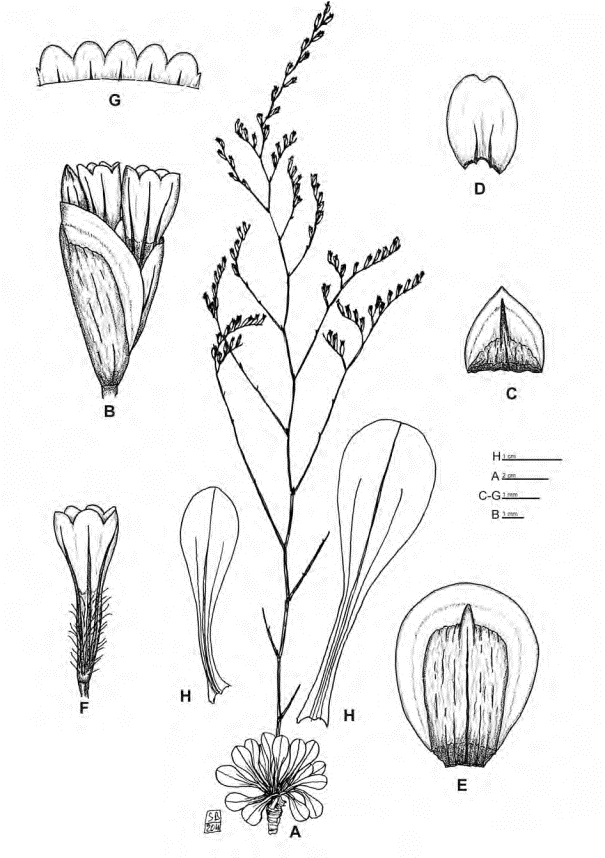
FIGURE 40. Limonium sieberi (Boissier) Kuntze. A) Habit; B) Spikelet; C) Outer bract; D) Middle bract; E) Inner bract; F) Calyx; G) Calyx lobes; H) Leaves. (Habit and leaves drawn from “Creta, Rethimno, Brullo & Pavone s.n., CAT”, spikelet details from “Crète, Rettimo ad Mare, Sieber s.n, M”).
1.Limonium sinuatum (L.) Miller (1768: no.6) (Fig. 1)
Basionym:-Statice sinuata Linnaeus (1753: 276). Type (lectotype designated by Erben 1978: 392):-ORIGIN UNKNOWN, Herb. Linnaeus no. 395.33 (LINN!).
Description:-Plant perennial, glabrous, forming a sub-shrub 10-45 cm tall, with several erect to procumbent stems and a robust tap-root. Caudices 0.5-3 cm long, branched, living leaves in rosettes at apices. Leaves fleshy, dark green to grey-green, normally flat, 20-150 mm long and 8-30 mm broad, oblanceolate to pinnately lobed, apex round, with a bristle, 1-4 mm long, with one central nerve and several pinnate lateral nerves, lanate at nerves and leaf margin, gradually tapering into the petiole. Stems with 4 undulate wings, 10-40 cm long, nearly straight, smooth, branching begins above the lower two third of the stems. Inflorescence triangular to obovate in outline. Sterile branches absent. Fertile branches 3-10 cm long, straight to slightly curved, directed obliquely upwards, forming branching angles of 35°- 45°, only longer branches divided in the upper half; second branches broadly winged, apical with 3 short, lanate appendices. Spikes short and dense, 6-13 mm long, straight. Spikelets fan- shaped, 12-15 mm long, composed of 2-3 flowers, very densely arranged with 7-11 per cm. Outer bract 4.3-5.8 mm long and 3.3-4.8 mm broad, triangular to small triangular-ovate, acute, with an awn, 1.0-2.5 mm long; bract in the upper half shaggily hairy; margin narrowly membranous. Middle bract membranous, 4.1-6.3 mm long and 2.9-4.2 mm broad, narrowly triangular, with 2 acute tips, every tip with one awn, 1.5-2.5 mm long. Inner bract 7.3-9.0 mm long and 4.3-6.6 mm broad, oblong-trapezoid to elliptical, 2-lobed; bract margin more or less broadly membranous; central part fleshy, green, oblong, on the upper end with 2 fleshy, clawed, shaggily hairy appendices. Calyx very narrow, 11.5-14.5 mm long; calyx tube shortly hairy; calyx lobes very small, semi-circular to triangular; calyx seam very plicate, blue. Corolla white to yellowish.
Chromosome number:-2n = 16 (Erben 1978, Artelari 1984a, Artelari & Georgiou 2003).
Distribution:-Mediterranean region. In Greece, it occurs in Sterea Ellas, Attika, Peloponnese, Kythira and several Aegean islands (Fig. 96 A).
Habitat:-Rocky coast on various substrates, sandy soils and ruderal habitats.
Taxonomic remarks:-L. sinuatum belongs to Limonium sect. Pteroclados and is related to L. lobatum, from which it differs in its perennial habit and by having calyces with very small lobes.
FIGURE 1. Limonium sinuatum (L.) Miller. A) Habit; B) Spikelet; C) Outer bract; D) Middle bract; E) Inner bract; F) Calyx; G)
Calyx lobes. (Habit drawn from “Creta, Brullo & Guarino s.n., CAT”, spikelet details from “Krete, Hofmeister, Herb. Erben”).
Basionym:-Statice sinuata Linnaeus (1753: 276). Type (lectotype designated by Erben 1978: 392):-ORIGIN UNKNOWN, Herb. Linnaeus no. 395.33 (LINN!).
Description:-Plant perennial, glabrous, forming a sub-shrub 10-45 cm tall, with several erect to procumbent stems and a robust tap-root. Caudices 0.5-3 cm long, branched, living leaves in rosettes at apices. Leaves fleshy, dark green to grey-green, normally flat, 20-150 mm long and 8-30 mm broad, oblanceolate to pinnately lobed, apex round, with a bristle, 1-4 mm long, with one central nerve and several pinnate lateral nerves, lanate at nerves and leaf margin, gradually tapering into the petiole. Stems with 4 undulate wings, 10-40 cm long, nearly straight, smooth, branching begins above the lower two third of the stems. Inflorescence triangular to obovate in outline. Sterile branches absent. Fertile branches 3-10 cm long, straight to slightly curved, directed obliquely upwards, forming branching angles of 35°- 45°, only longer branches divided in the upper half; second branches broadly winged, apical with 3 short, lanate appendices. Spikes short and dense, 6-13 mm long, straight. Spikelets fan- shaped, 12-15 mm long, composed of 2-3 flowers, very densely arranged with 7-11 per cm. Outer bract 4.3-5.8 mm long and 3.3-4.8 mm broad, triangular to small triangular-ovate, acute, with an awn, 1.0-2.5 mm long; bract in the upper half shaggily hairy; margin narrowly membranous. Middle bract membranous, 4.1-6.3 mm long and 2.9-4.2 mm broad, narrowly triangular, with 2 acute tips, every tip with one awn, 1.5-2.5 mm long. Inner bract 7.3-9.0 mm long and 4.3-6.6 mm broad, oblong-trapezoid to elliptical, 2-lobed; bract margin more or less broadly membranous; central part fleshy, green, oblong, on the upper end with 2 fleshy, clawed, shaggily hairy appendices. Calyx very narrow, 11.5-14.5 mm long; calyx tube shortly hairy; calyx lobes very small, semi-circular to triangular; calyx seam very plicate, blue. Corolla white to yellowish.
Chromosome number:-2n = 16 (Erben 1978, Artelari 1984a, Artelari & Georgiou 2003).
Distribution:-Mediterranean region. In Greece, it occurs in Sterea Ellas, Attika, Peloponnese, Kythira and several Aegean islands (Fig. 96 A).
Habitat:-Rocky coast on various substrates, sandy soils and ruderal habitats.
Taxonomic remarks:-L. sinuatum belongs to Limonium sect. Pteroclados and is related to L. lobatum, from which it differs in its perennial habit and by having calyces with very small lobes.
FIGURE 1. Limonium sinuatum (L.) Miller. A) Habit; B) Spikelet; C) Outer bract; D) Middle bract; E) Inner bract; F) Calyx; G)
Calyx lobes. (Habit drawn from “Creta, Brullo & Guarino s.n., CAT”, spikelet details from “Krete, Hofmeister, Herb. Erben”).